2025 Product Roundup
2025 was a big year at DrugBank. We’re looking back at some of the biggest product releases and data updates that helped researchers explore the pipeline earlier and connect the dots across discovery and development.


We made some exciting moves, and you were a huge part of that transformation. From major product releases to the addition of crucial new data, every step we took was guided by a single goal: making it easier for biotech and pharma researchers to unlock drug discovery and development success.
Let’s take a look back at what we’ve accomplished in 2025, and take a sneak peek at where we’re headed next.
Faster, more structured drug evaluation
Evaluating drug and disease opportunities has traditionally meant pulling together scientific, competitive, and clinical insights from many disconnected sources. Over the past year, this challenge guided our product releases.
Build structured analyses quickly with Table Builder
Early in 2025, we launched Table Builder, a powerful tool that enables you to quickly build structured data tables across drugs, trials, proteins, and diseases. With instant access to DrugBank’s trusted knowledgebase you can add data, then narrow in by modality, clinical trial phase, indication, trial sponsor, and many other parameters, enabling you to rapidly answer complex research questions.
Move from question to insight using the AI Assistant
The AI Assistant makes exploring DrugBank’s data even easier by delivering complex data tables for research questions asked in plain language. You can start building a data table by asking the AI Assistant a question, such as “What drugs in development target proteins containing an SH2 domain?” without ever needing to understand the underlying data structure or filtering logic.
The AI Assistant can support complex conversations, provide summaries and insights directly from your table, and suggest relevant next steps to keep your work moving forward.
Earlier visibility into the clinical pipeline
Gaining a clear view of the active clinical pipeline has long been limited by delayed visibility and fragmented context across traditional industry resources. Over the past year, we focused on surfacing investigational drugs earlier, and pairing that visibility with usable scientific and clinical detail.
Keep pace with continuous clinical coverage
To help you stay on top of the evolving drug landscape, and reduce the manual effort required to track clinical activity, we upgraded our systems to deliver faster, more continuous coverage of investigational drugs across their clinical trial phases.
Drug records have been consolidated into a single entity, linking synonyms, and investigational codes, including proprietary identifiers and International Non-proprietary Names (INNs). Trial data is now consistently added days after any changes to ClinicalTrials.gov, ensuring faster and more accurate visibility into trial activity.
Surface insights earlier with Journal Reader
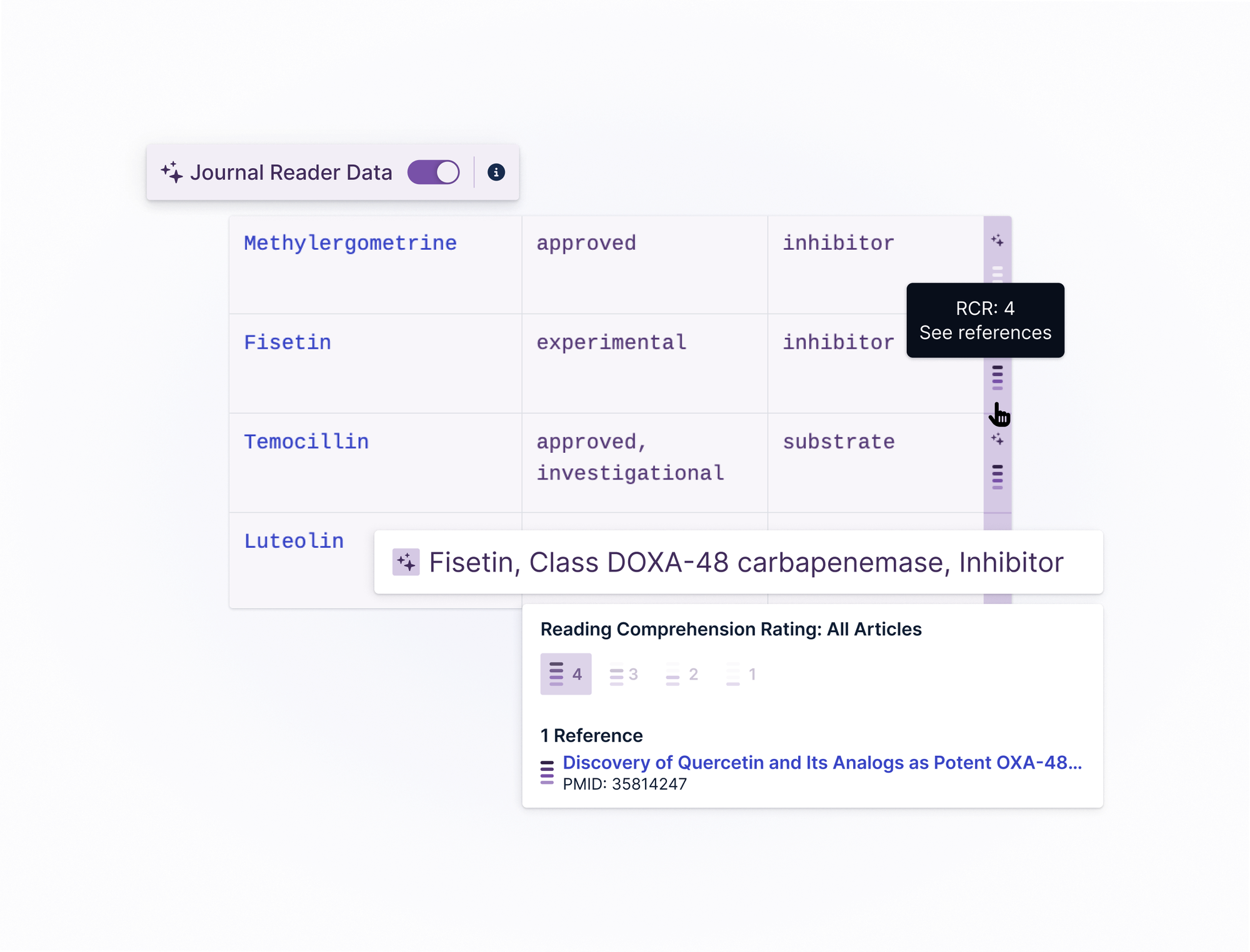
Journal Reader, powered by our proprietary AI, surfaces insights from newly published PubMed articles and makes them available as part of your broader analysis in Table Builder. When enabled in a Protein or Drug table, this data helps connect emerging drug–target relationships to underlying biological hypotheses. By bringing these insights into your workflow earlier, Journal Reader creates visibility into mechanistic signals that often precede formal pipeline activity.
Investigate early signals with Exploratory Drug Cards
As part of a new drug card categorization system, we introduced Exploratory Drug Cards to capture clinical drugs that have limited available data. Designed to support early-stage investigation, these cards are especially useful when scanning what is emerging across therapeutic areas, competitors, and modalities, or when identifying drugs that may warrant follow-up. These connections help surface early signals, support preliminary drug-trial analysis, and enable exploration of related drugs within the same therapeutic area or modality.
Clearer biological and commercial context
Drug discovery and deal-making increasingly begin with a biological mechanism or a disease area, not a single drug. Understanding what else might be happening around these starting points is critical for strategic decision-making.
Over the past year, we expanded beyond a drug-first view to map targets, diseases, trials, and related assets, even when no drug is directly involved. With this broader context, a clearer and more complete picture of the biological and commercial landscape is now available. This makes it easier to spot opportunities, understand context early in diligence, and make informed decisions with fewer blind spots.
Explore off-target biology at scale with our EvE Bio integration
EvE Bio is a research organization that is mapping how FDA-approved drugs interact with proteins across the proteome, including effects beyond a drug’s intended target. We partnered with them to integrate their data and deliver you hundreds of thousands of additional drug-protein interactions for roughly 1,400 small molecules and hundreds of targets. This expanded view supports deeper exploration of off-target effects, drug repurposing opportunities, drug interactions, and multi-target therapies that were previously unavailable at this scale.
Track trial evolution with improved historical coverage
This year, we established consistent historical coverage for investigational drugs, with up to five years of clinical trial data now available in DrugBank. This historical foundation allows you to see how a drug has moved through clinical trial phases over time, making it easier to understand development timelines, spot patterns across similar programs, and evaluate pipeline maturity with greater confidence.
Explore disease landscapes with confidence
Clinical trial databases like ClinicalTrials.gov don't use formal disease ontologies, making it difficult to find all relevant trials for a given condition. Over the past year, we've addressed this by strengthening how diseases are structured in DrugBank, ensuring that primary diseases, subtypes, and related indications are consistently identified and correctly linked, even when different clinical terms or labels are used across sources.
Disease-based searches now surface all relevant trial activity, targets, and therapeutic work associated with a disease area. You can more reliably examine disease biology, compare related indications, and understand how research activity is distributed across an entire disease spectrum without missing trials hidden behind inconsistent terminology.
See the complete picture of sponsor involvement
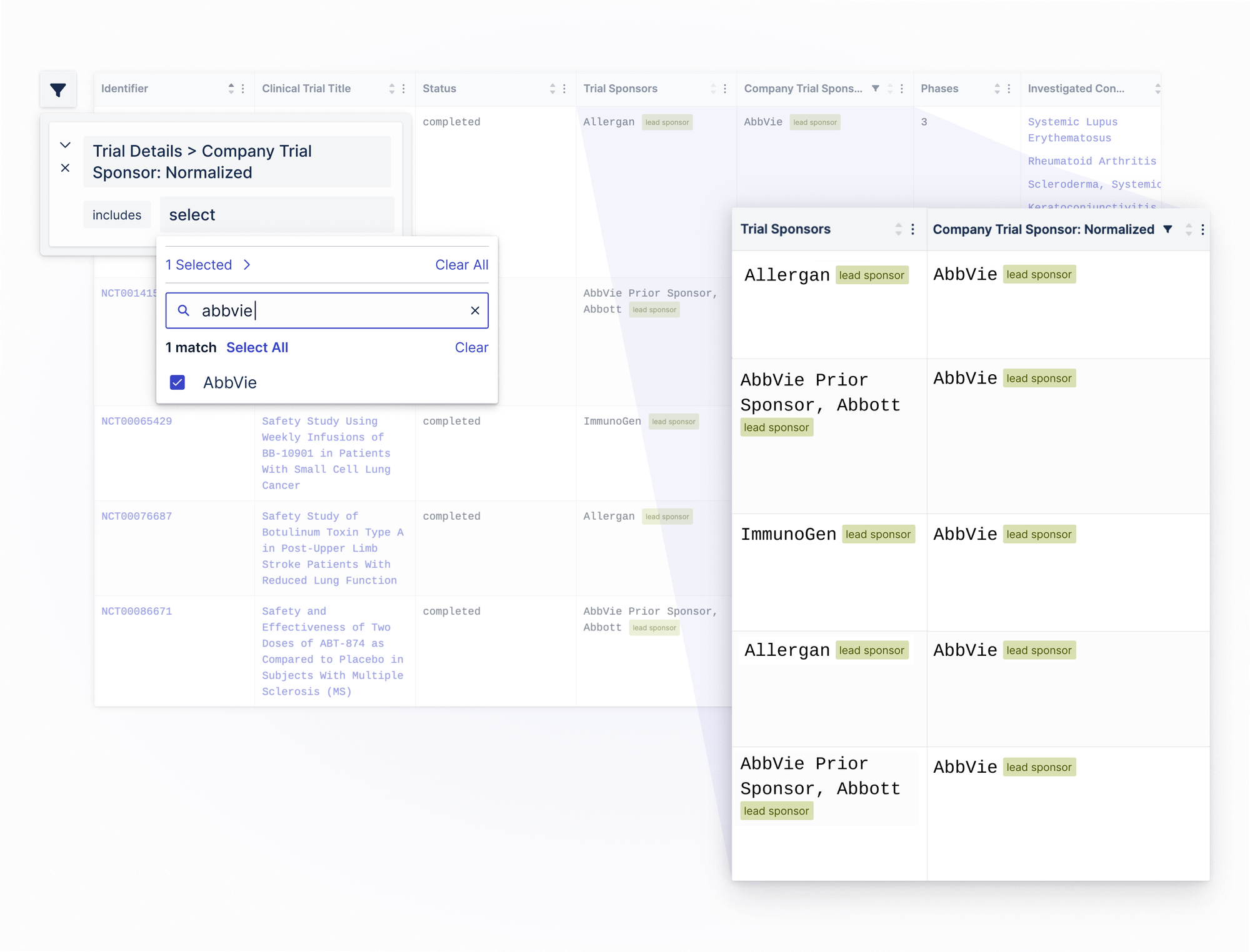
Clinical trial sponsors are often listed under different names or corporate structures. To make it easier to understand the full scope of a company’s trial activity we have begun to standardize sponsor identities. So far we have identified more than 200 leading pharmaceutical companies, and brought trials reported under subsidiaries, historical names, or rebranded entities under a single, consistent name.This ongoing work will continue to take shape into early 2026.
Designing for what researchers need next
Everything we shipped in 2025 was driven by a desire to help you move from complex data to confident decisions faster, with fewer gaps, and less friction. Whether it’s earlier visibility into emerging trends, clearer biological context, or tools that adapt to how you actually think and ask questions, we’re continuing to evolve alongside the realities of modern drug discovery.
As we move into 2026, you’ll see deeper integrations across data types, more powerful AI-driven workflows, and new ways to surface insights that matter at the exact moment you need them. We’re grateful to be building alongside you, and we’re excited for what’s next.