Spring 2026 Product Roundup
A busy start to 2026 at DrugBank. From new ways to access our knowledgebase to sharper clinical trial navigation, here’s a look at our recent product and data releases that help biopharma teams turn data into conviction.

We kicked off 2026 strong, building across three fronts: new ways to access DrugBank, deeper biological coverage for earlier-stage research, and closing the gaps that make clinical trial research harder than it should be.
Drug discovery and strategic decisions increasingly depend on connecting the dots across science, pipelines, and companies, so we made it easier to piece the picture together. Here's a look at what shipped so far this year, and what it unlocks for your research.
DrugBank intelligence, wherever you work
Over the last quarter, we focused on making DrugBank intelligence something you can pull into any part of your workflow — from your AI tool, to your spreadsheet, to a colleague’s inbox.
Access DrugBank directly from your AI tools
You can now query DrugBank’s trusted data foundations directly from your AI tool through Model Context Protocol (MCP) integration. Available in tools like ChatGPT, Claude, or your own custom agent that supports MCP. Learn more here.
This new access point for DrugBank intelligence opens up new capabilities:
- Grounded answers, fewer hallucinations. Queries pull from DrugBank's high-integrity data, reducing the risk of misinformation that comes with sourcing the open internet.
- Faster time-to-value. Integrate DrugBank into your agentic workflows without the heavy lift that APIs typically require.
- Bridge with other tools. Pair DrugBank with resources like Open Targets; bridge various data sources together in a single conversation.
- Move straight into the next step. Turn the insights you pull into summaries, reports, and slide decks directly in your AI environment.
Take Table Builder results anywhere
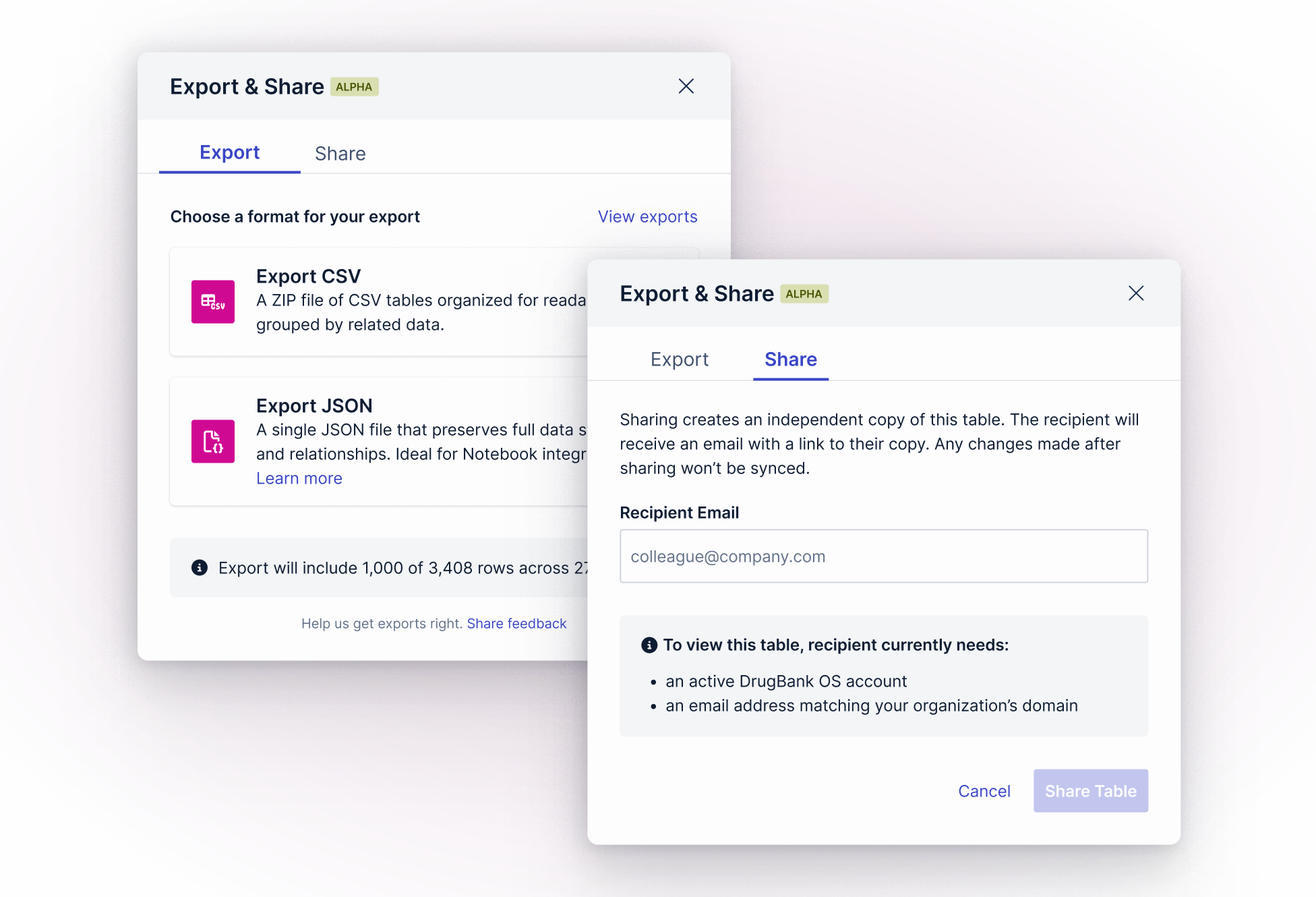
You can now export Table Builder results as a CSV or JSON, making it easy to bring findings into spreadsheets or computational notebooks for further analysis, combine with proprietary data, or reformat for reports and presentations. Our new table sharing capability also lets you send a pre-configured table to a colleague, whether to share findings or give them a ready-made starting point for their own investigation. These changes make DrugBank findings more portable, collaborative, and easier to build on.
Deeper biological foundations for earlier discovery
Deals and drug discovery increasingly form around a mechanism or disease strategy rather than a single molecule, which means having rich, interconnected biology is essential from the earliest stages. We significantly expanded the biological and investigational drug data so you can follow those threads earlier, even when no approved drug exists yet.
Track investigational drugs earlier in the pipeline
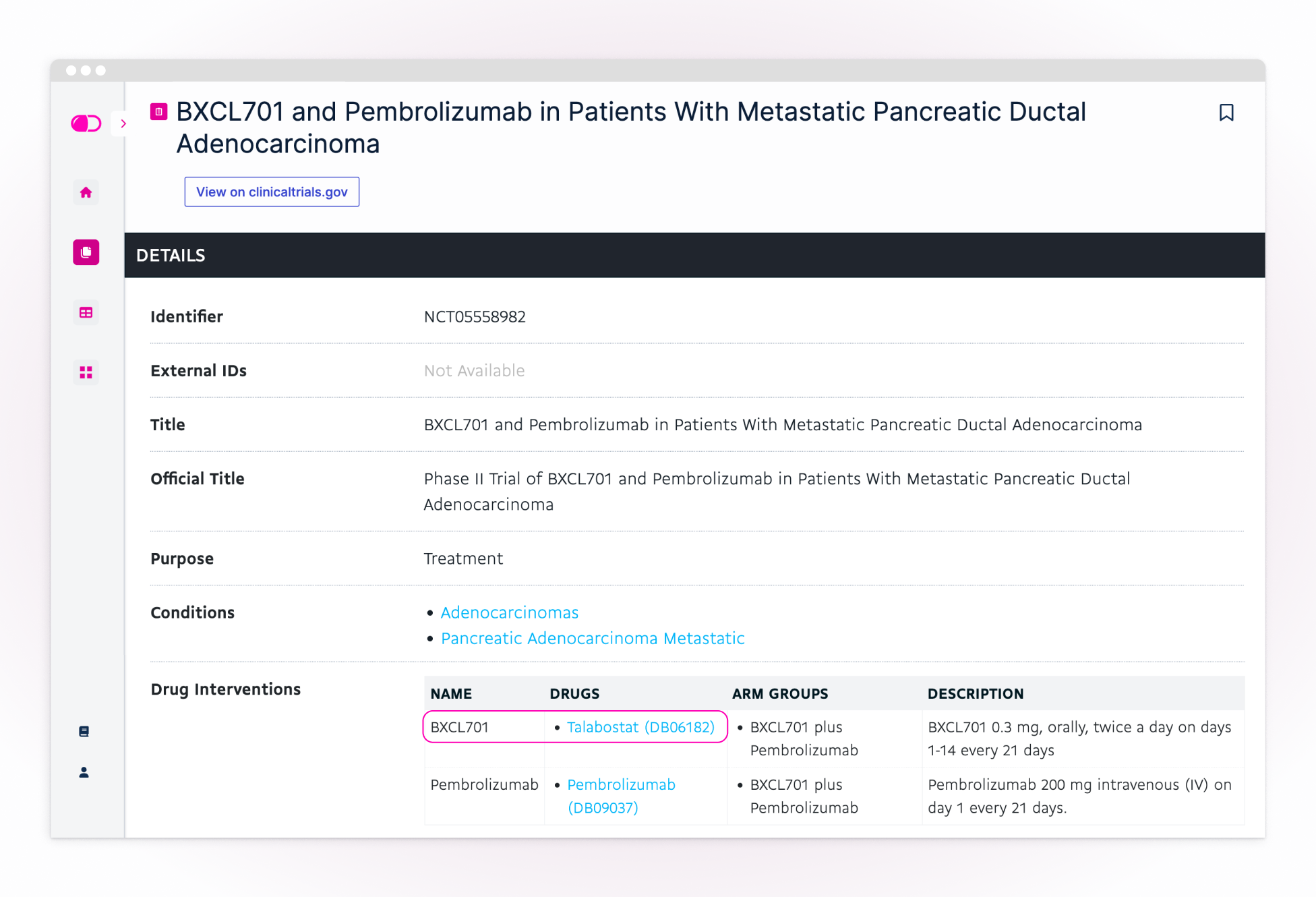
We added the last five years of investigational drugs in clinical trials, giving you greater historical context to evaluate development timelines and pipeline maturity. New drugs also appear within days of their trials being posted to ClinicalTrials.gov, so you’re always up-to-date on the latest investigational activity.
Drug synonyms, identifiers, and investigational codes are consolidated under a single entity so you can track a drug across rebrandings, partnerships, and code changes without losing the thread. And because drugs connect to trials, conditions, and companies, each investigational drug becomes a starting point for exploring the broader landscape around it.
Explore biology beyond known drug targets
We significantly expanded the biological data foundation enabling your research, supporting target identification, prioritization, and mechanistic research well before a drug exists. New additions include:
- The entire human proteome. Investigate undrugged targets with the addition of every Swiss-Prot-reviewed human protein, adding 16,500 new proteins.
- All human pathways from PathBank. Better understand how drugs impact biological systems, not just targets in isolation, with the addition of 156,000 new pathways.
- Pfam clan data. Search and group proteins by structural or sequence similarity to identify druggable families and understand mechanistic relationships.
Navigate the clinical pipeline with greater precision
Clinical trial data is full of inconsistencies, from varying drug codes to fragmented sponsor names across subsidiaries, rebrandings, and acquisitions. For teams making high-stakes decisions on where to invest, these gaps mean incomplete views of the landscape, missed opportunities, and blind spots you didn’t know you had.
We focused on closing key gaps so you’re working from a complete, accurate view of what’s out there.
Systematically screen trials by eligibility criteria
Eligibility Criteria from ClinicalTrials.gov are now available in Table Builder, bringing a new level of depth to your trial evaluation. You can filter on unstructured eligibility criteria data with a new AI-assisted filter that can help you write precise filter criteria. Once applied, it will highlight matching results directly in the table so you can quickly find what you need.
Instead of spending weeks reading individual trial protocols, you can now quickly map the landscape to find assets based on your search criteria. This enables you to identify trials aligned with your indication, population, or competitive focus, see how competitors are defining and segmenting patient cohorts, and spot gaps in eligibility criteria that signal new partnership or acquisition opportunities.
Investigate every drug trial with clearer drug linkages
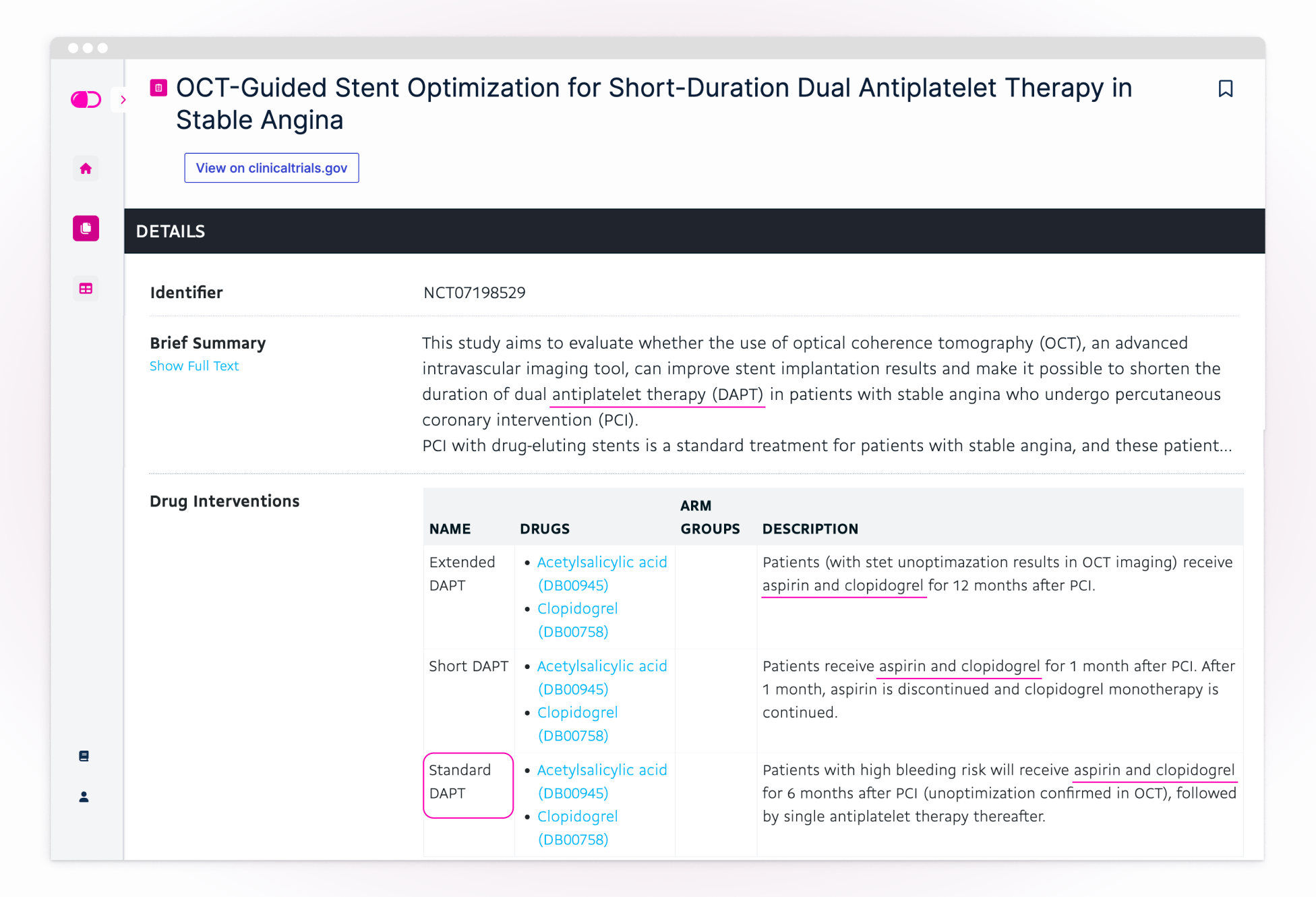
We expanded clinical trial coverage with the addition of 40,000 new trials to include every trial with a drug intervention, giving you greater visibility into the clinical landscape. Trial records also now include improved drug linkages that resolve the inconsistent drug reporting you often see on ClinicalTrials.gov, augmenting a third of drug trials from the last five years with 65,000 new drug-intervention links.
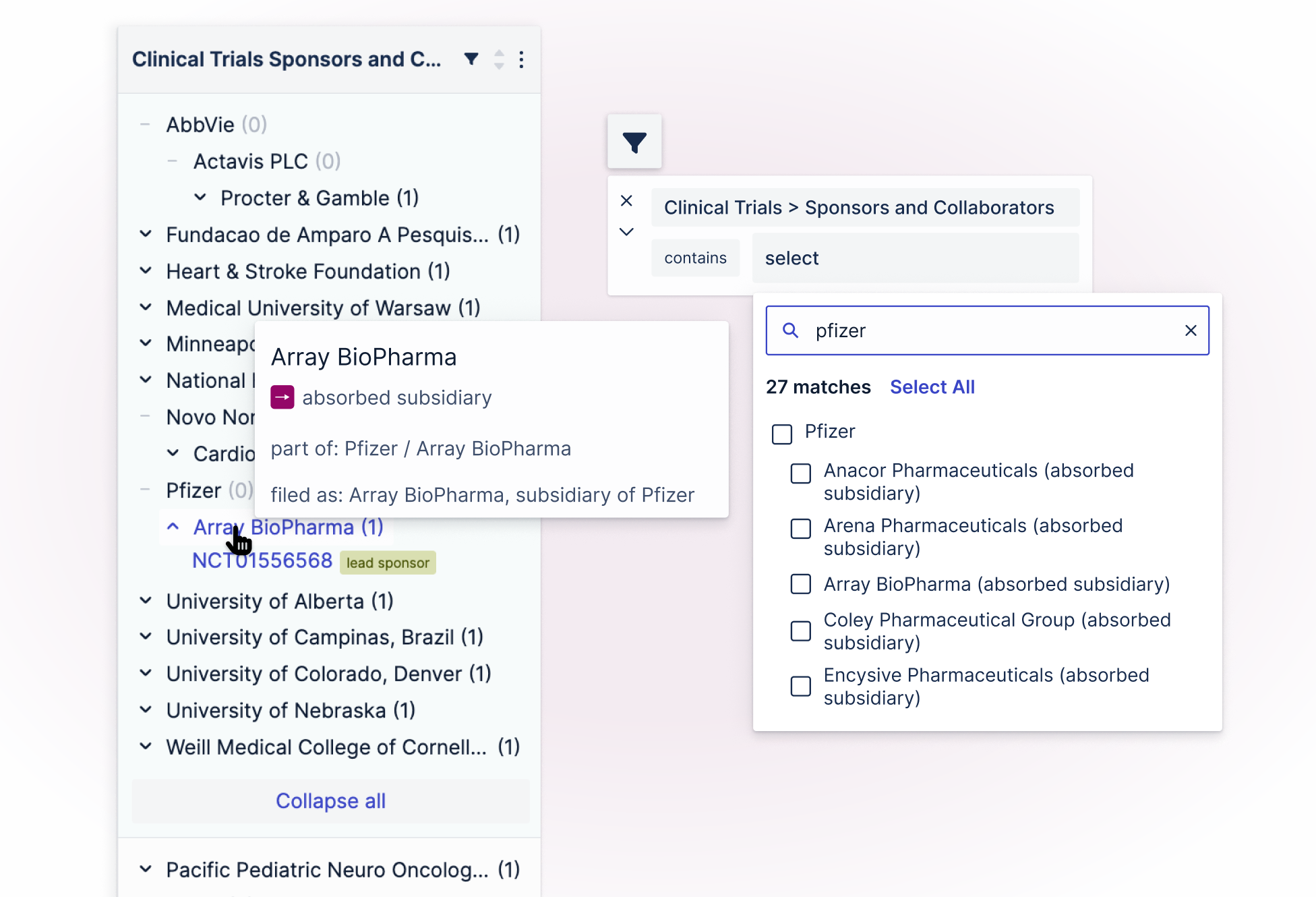
Uncover the full trial footprint behind every sponsor
Clinical trial sponsors and collaborators are often listed under dozens of name variants, from abbreviations to subsidiaries to legacy names. A misspelled name or synonym can mean an incomplete picture of who is involved in what, resulting in blind spots in your research.
Every trial sponsor and collaborator is now mapped to a unique, normalized company entity, with parent-subsidiary relationships captured and maintained for the top 50 pharmaceutical companies. This means a more complete picture of the who’s behind each trial, allowing you to better evaluate competitive landscapes and pipelines, identify competitive overlap across a therapeutic area, drug, or indication, and see where companies are investing.
Previously, searching for a company wouldn’t have included all trials filed under its subsidiaries or registry variants. Now, you get the full picture. In Pfizer’s case, that meant going from 4,193 attributed trials to 5,930, representing a 41.4% increase in trials linked back to Pfizer.
What's next
Everything we built so far in 2026 is focused on the same goal: making it easier for our users to connect the dots between scientific and commercial data to arrive at confident drug investment and discovery decisions. Whether that’s accessing DrugBank intelligence inside your AI tools, having more rich, early-stage biology to explore, or navigating trial data with fewer blind spots, we're building toward a version of DrugBank that works as infrastructure for modern drug discovery.
Looking ahead, expect more on strengthening connections between scientific and commercial data and accelerating how you get from question to insight. As always, thank you for building alongside us.